

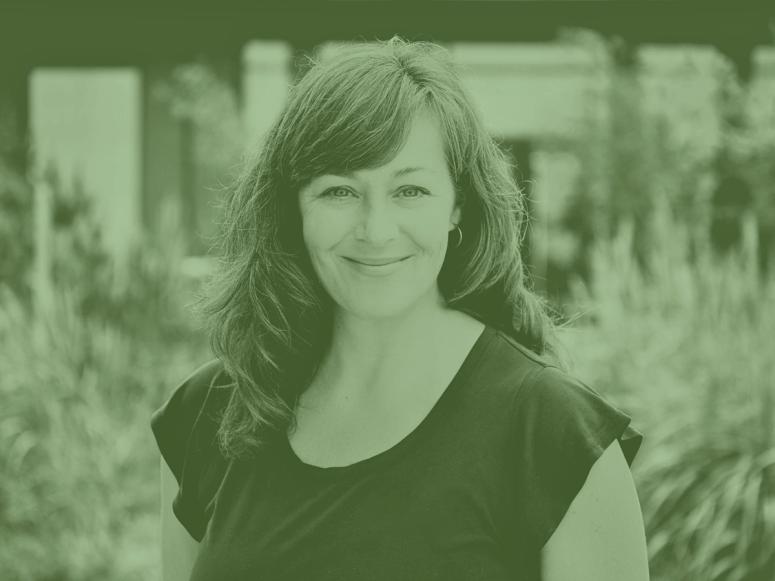
The writer, speaker, and biomechanist Katy Bowman is at the forefront of the “movement movement,” which aims to challenge the way we perceive movement and how we incorporate it into our daily lives. Transcending traditional exercise routines, her work focuses on the concept of “movement nutrition,” a kind of bodily nourishment achieved through both full-body engagement and targeted exercises for individual body parts. As one of journalist and former first lady of California Maria Shriver’s “Architects of Change” and a prominent figure in the “walking movement,” Bowman has collaborated with companies such as Patagonia, Nike, and Google; authored several books, including the best-selling Move Your DNA (2014), Movement Matters (2016), and most recently, Rethink Your Position (2023); and founded the Washington-based company Nutritious Movement. Across all of her work, she promotes her message of “move more, move more body parts, move more for what you need.”
Here, Bowman discusses how “movement malnutrition” impacts our health, argues for making better daily movement choices, and highlights the importance of reintegrating ancestral movements into our lives.
In Move Your DNA, you note that many ailments today are related to insufficient movement. Can you explain what you call “movement malnutrition,” and how it impacts our health?
We could start with what movement nutrition is. As a framework, it looks very similar to dietary nutrition, where not only do you require sufficient calories, but your calories need to contain the right macronutrients—fat, protein, carbohydrate. Micronutrients would be the next level. Even with a good blend of macronutrients, it’s quite possible to still have nutritional deficiencies. Movement nutrition is the same. We need to move enough—that would be the equivalent to [consuming enough] calories—through certain categories of movement, balanced well—for instance, cardiovascular, strength, mobility, and flexibility.
What would be the equivalent of the micronutrients?
Even if you labor all day, you might just be doing the same movements over and over, so you could have parts of your body that are overused and parts that are underused, in the same way that you could be eating nutritious food, but only one or two specific food items. A healthy movement diet includes not only moving more—which is where a lot of people stop thinking about it—but also the diversity of the movements. You might see a physical therapist for your micronutrients, for instance, if you’ve sustained an injury in a tiny muscle that never gets used and they give you an exercise to ameliorate that. Or you might have a small habit that is overusing this or that movement food, and you need to dial it back.
What are some practical tips for making better movement choices throughout the day? I know you are especially an advocate of a daily walk.
Yes, let’s start breaking things down a bit. You need your daily moving calories, but just as you wouldn’t want to eat an entire day’s food in one sitting, you don’t have to get your movements in all at once, and in fact it’s better not to. If you can find ten- or fifteen-minute opportunities over the course of the day, that might be an easier way to get more movement calories. Then as far as macronutrients, if you are moving for exercise or for pleasure, perhaps you could get to work on your bike rather than via car or bus. Start considering a diversification of your modes of movement, lest you be drawn to the same movement meal again and again.
Even if you have a regimen that’s working for you, try to add to it. If you ride your bike daily, maybe add fifteen minutes of dancing in the kitchen—something that looks very different. Or if most of your movement is cardiovascular and intense, stretch while you’re watching TV at night, so that you get a different category of movement in those minutes.
What are some tips for getting in our movement micronutrients?
Start thinking of the shape of your body throughout the day. I explain it this way: If you imagine a star at every one of your joints, your body is making a constellation. So there’s a constellation while working on the computer, a constellation while taking a walk, a constellation while riding a bike. Can you refine those constellations, for instance, by improving your posture at your desk? You have many joints in your body, and they’re there to allow you a different way of doing the tasks that you’re already doing. Think of a star for every single one of your vertebrae—not just, you know, a star at your shoulder and a star at your hip. The more you change up those shapes, the more movement micronutrients you’ll be getting.
How can people set up their workspaces to promote better bodily alignment and reduce the risk of musculoskeletal issues?
You could try enacting different constellations while doing whatever your work is. My advice is the same, whether you’re doing computer work or much more physical work. You can adjust your pelvis, adjust the position of your head, change the curve of your spine. Mix up what you sit on. If I were on a ball right now, my constellation could be constantly shifting while I’m doing my work—some parts of me would be active even as other parts were relatively still.
You note in your book Rethink Your Position that extremely simple movements such as chewing can impact cognitive function and overall mental well-being.
Yes. The shape of our anatomy is quite old, even if the environment it occupies is quite new. We can all easily imagine what would happen to our leg muscles if we very rarely got up out of a chair: They would atrophy. But our muscles aren’t just moving us around. Their movements also serve multiple functions like delivering nutrients, getting oxygen to different tissues of the body, aiding the immune system.
One of our strongest muscles is in the jaw, the masseter muscles. Our diets have changed so radically that we’ve stopped masticating tough foods. Many of our calories are now literally taken as liquids. But it turns out that regular chewing is part of how the brain gets its blood flow. Society doesn’t need us to use certain muscle groups very much anymore, but our physical tissues evolved in a context where those movements were always happening. I’m starting to see jaw exercisers on the market, because researchers do recognize that this is an issue. But could you just look at your diet and ask yourself: “Am I drinking a lot of my calories? Could I instead eat more whole carrots, whole apples, dried fruits, dried fish?”
Many people experience daily aches and pains. How can they identify the specific areas of their body that need attention? What are some simple exercises or adjustments to improve those areas?
Most people know which areas of their body don’t feel good simply by listening and paying attention. But just because a certain area of your body is experiencing pain doesn’t necessarily mean that the missing micronutrient pertains directly to that area. I teach people how the anatomical parts articulate [themselves]. Maybe your shoulder joint needs rotation, either internal and external. Through trying out little movements, head to toe, we see where certain parts move well and others don’t. It’s quite prescriptive in nature. It requires having someone who knows how those parts move watch you and instruct you, and then learning how to evaluate yourself.
Your book Move Your DNA notes that the human body evolved to perform specific moments like walking, squatting, hanging, and carrying. In a convenience-centric culture, how can individuals reintegrate these moments into daily life for better overall health?
Well, we should clarify that many of these movements are still intact in many cultures around the world. But to answer your question, sitting and standing and squatting are things you inevitably do all the time if you have children. But still, you can create a situation at home where not all the sitting surfaces are exactly a chair’s height. Opt for sitting directly on the floor! Walking is, again, not an outdated movement, although it’s rapidly becoming very unpracticed. But walking to do chores, walking for entertainment, walking with friends for bonding time—giving purpose to walking is one key way to help preserve it.
Movement comes very naturally to children, but as we grow up, we’re no longer spending our free time in places like playgrounds or trees. So can you convert your living space into something more like those environments? Can you install a pull-up bar in a doorway? It’s low-profile, it’s not an eyesore, it’s easy. And it allows you to cultivate a really nourishing upper-body movement and grip strength. Our grip strength is collectively diminishing as more people swipe and type as opposed to hand and arm movements that require more muscles.
My grandmother, who is 87, walks to the farmer’s market, then carries her vegetables back home. It brings her joy, and it’s beautiful. We say, “Grandma, can I do that for you?” And she replies, “No, no, I love doing it.”
The joyful part is so important. When you’re in your middle age, the busiest age, you think, “It’s so much better to get this done faster. Or maybe I don’t even have to do it, I’ll pay someone else to do it.” But when you get to the age where things slow down a little, you want to still be strong enough to take care of yourself. Not just the physiology, the brain and the body, but the way you think about yourself as being relevant and capable. And you have to do it through middle age to be able to do at an older age; it is incredibly difficult otherwise. Your older body is dictated by what you do in your middle age, just like your middle age is dictated by what you did in your earlier age.
We’re the first generation to wholesale jump on the “someone else can bring me everything” bandwagon.
This is all outside of disability, of course. If you have disabilities, it’s quite possible that you need to outsource certain motions. But working to your personal capacity, whatever it is, is crucial.
Your book Movement Matters explores the connection between sedentarism, privilege, and nature. How can individuals become more aware of their personal relationship with sedentarism and make conscious choices to increase movement in their lives?
Much of my work involves teasing out the difference between movement and exercise. We tend to pursue movement these days in the form of exercise only. But it’s very challenging to exercise multiple hours a day, because when you’re exercising, that’s the only thing that’s happening. Only people with abundant free time are able to do that. There’s a very small category of people for whom adequately tending to their body through exercise is a possibility. For the rest of us, we need to fit movement into the non-leisure moments of life: moving more for transportation, moving more in the home. People don’t even clean their homes much anymore—they hire others to clean, or they get a robot cleaner. People used to wash and hang all their own laundry.
Don’t just ask yourself, “Did I exercise today or not?” You can call yourself active when really you’re still quite sedentary. You can begin to change your relationship with sedentarism by paying attention. Look around and realize, “Hmm, I’ve outsourced most of my movement to other people.” Or, “I’m spending almost all of my time inside my dwelling.” Embrace discomfort. Live more outside of the exoskeleton you’ve built. Being outside not only takes more movement, it involves regulating your temperature via either sweating or goosebumps, shivering. These are valuable bodily movements. If you never leave spaces that are thermostat-controlled, you lose these abilities to move. Try eating outside. Go on a picnic. You were going to eat lunch anyway—why not do it sitting on the ground? Now you’re working on your flexibility, too.
To finish, what to you, Katy, is the good life?
The good life is meeting all of my actual needs—sleep, food, movement, community, nature—with as little distraction from the nonessentials as possible, but punctuated with regular celebrations. Celebration is so important to me for a good life.
Keep reading

The California-based multidisciplinary creative and writer Lindsey Bro—known particularly for her book, Thermal: Saunas, Hot Springs & Baths—has, throughout her career, embarked on odysseys within the realms of bathing culture, exploring its allure and culturaThermal guides readers through the storied history of global bathing traditions, weaving together the rich tapestry of culturesonsen—coexists with contemporary well-being practices.

Through her health practice Doing Well, the integrative nutritionist Daphne Javitch has built a cult following around heRachel Comey, the food artist Laila Gohar), topic-driven sessions on different health subjects (aging, sex, backmapping), and recipes (halibut and caper sauce, tomato sauce, brothy avocado). A large part of her appeal is her fashion-adjace

For Vivian Rosenthal, a trained architect and the co-founder of Frequency Breathwork, breath provides the structural starting point around which a good life gets built—it’s the foundation for all that groclasses that she guides from Souk Studio in Manhattan’s Flatiron neighborhood and at off-site events.

The Los Angeles–based energy healer, teacher, wellness entrepreneur, and self-described “multidimensional multi-hyphenather own platform, she offers an “Inner Child” healing workshop and a seven-day breathwork mini course, and also publishes a Friday email newsletter called 11:11.

As the founder of BAO (Black Apothecary Office), Jaé Joseph aims to create more than just another skin care company with yet more hydrating and exfoliating cleansers,consumed,” he says. “Forty to forty-two percent of the client base for my product line are not people of color.”

Leonard Koren may have written nearly 20 books over the past four decades, but he doesn’t consider himself a writer. “I creator,” he says. “I’m interested in exploring things that I’m curious about and trying to figure out what it is that makes thonsens, explored in books including New Fashion Japan (1984), 283 Useful Ideas from Japan (1988), and How to Take a Japanese Bath (1992). Perhaps his most widely known book is Wabi-Sabi for Artists, Designers, Poets & Philosophers (1994), which introduced—cemented, even—the term wabi-sabi in the West and has become a cult classic over the nearly 30 years since its publication.

Since launching the organization Black Girls Breathing nearly five years ago, in October 2018, the Atlanta-based trauma- and grief-informed breathwork practitioner Jasmine Ma

It’s a Friday in the late afternoon, and I’m standing with Ivy Ross, Google’s vice president of hardware design, and SusYour Brain on Art: How the Arts Transform Us (Random House), which takes a scientifically backed look into neuroaesthetics—or, in other words, how engaging with art

The first time I ever set foot in the Manhattan studio of the practically indefinable artist-metalsmith-painter-engineerwho died on Nov. 26, 2022, at age 75, he was looking directly at me through his jewelers loupe, which was firmly fastened around his head, just as I exited Himself. This close-up view was how he saw things. He looked at the world, and the cosmos at large, in microscopic detail. Dani

A few years ago, some days after my birthday, a cardboard shipping tube appeared at my door, beige and unassuming, addre

How or when do we talk about the books that move us? Perhaps at a dinner party. With a bookstore clerk or librarian. May

What gives a physical movement meaning? There are myriad answers: context, shape, intention. For internationally renowneDimitri Chamblas, there’s another, primary answer: speed. “If I go to shake your hand, you would understand because of the movement, but

In 1940, Dorothy Kunhardt published a book that would forever change the way young children read. Pat the Bunny, an interactive book full of activities such as touching the sandpaper of “Daddy’s scratchy face,” playing peekaboo witA.S.M.R.-level crunching sound, while the use of faux rabbit fur or horse hair offers an exhilarating tactile experience. As we

With everything he does, the Los Angeles–based designer and creative director Willo Perron always considers the macro an

Designed in 1972, at a time when a luxury watch made of steel was still a radical concept, Audemars Piguet’s nautical-inGQ editor Bill Prince, author of the new book Royal Oak: From Iconoclast to Icon (Assouline), coming out October 12. “It’s one of those works of culture that has managed to cut through time, in the sebigger than the era.”

Hiring a world-class architecture firm to design a tiny temporary retail space may seem an extravagant choice, but given

In co-founding Slow Factory in 2012—a Brooklyn-based nonprofit dedicated to advocating for slow fashion and advancing climate justice and social eqthe latest guest on our Time Sensitive podcast—created a platform to further one of her life missions: to replace socially and environmentally harmful and outdated sy

For Janne Saario, a former professional skateboarder turned skate park designer, the best skate parks exist in harmony w

As one of the world’s foremost trend forecasters, Lidewij Edelkoort has advised companies ranging from Coca-Cola to Lacoste on everything from how to communicate with emerging youth archeTrend Union—that forecast market movements two or more years in advance. In the textile industry, her research has been used by fas

The first attempts to create language around matter—at least in the tradition of European philosophy—began with an obserhyle,” or that which receives form or definiteness. The notion of hyle proposes the idea of a universal basic substance from

With the climate crisis a chief concern of worldly citizens, Fortune 500 corporations, the United Nations, and even the U.S. Department of Defense alike, a “made from recycled water bottles” origin story has practically become ubiquitous. Now more than ever shoppersFirst Mile, though, doesn’t see recycled bottles as a marketing ploy; they see them as a tool for empowering consumers to demand m

The organ often shocks by the strength of its scale alone. Few other instruments, after all, can be so large as to necesOrgan Scholarships from Oxford’s Magdalen College in its 560-year history and, shortly thereafter, at age 21, becoming director of music f

A motorcycle, at its most basic, is merely an object: two wheels, an engine, and a seat, on which a rider (if not a kick

Taking on the finest Swiss watchmakers, Japan’s Grand Seiko has risen to the top of the industry with its mix of beautif

Writer Hannah Lewis says she practically fell in love with Japanese botanist Akira Miyawaki when she first read the 2007The Healing Power of Forests, which he co-authored with ecologist Elgene O. Box. The book introduced the Miyawaki method, a reforestation technique Compendium of Scientific and Practical Findings Supporting Eco-Restoration to Address Global Warming, a bi-annual, open-access compilation of scientific studies, industry and government reports, and journalistic investigwrite an article about the approach for The Guardian in 2020, and a just-released book of her own: Mini-Forest Revolution: Using the Miyawaki Method to Rapidly Rewild the World (Chelsea Green Publishing).

For time immemorial gardens have served as spaces for rest, reflection, and communion with the natural world. But in todhas written, “Ultimately, every garden is an ideology.”

“What is the texture of scale? Can a surface be eliminated? Can space expand?” Viewers encounter these and other questioObjects in Sculpture” (through Oct. 10), Minnesota-based designer Jonathan Muecke’s first solo presentation in a major museum. For Muecke, a

Among all the significant seats in the design canon, few are as recognizable as Emeco’s 1006 Navy Chair, which was designed in 1944, in the midst of World War II, for the U.S. Navy. Resourcefully made from

In a city boasting many of the world’s greatest art museums, it’s perhaps easy to overlook the jewel that is the Morgan Library & Museum, which spans more than half a block, between Madison and Park Avenues, in Manhattan's Murray Hill neighborhood. But witmultiyear restoration of the original library building’s exterior finally complete, as well as the just-overhauled Morgan Garden, unveiled la2006 expansion by Pritzker Prize–winning Italian architect Renzo Piano, which integrates the site’s three historic buildings within th

With practically everything they do—or at least with their many time-honored ceremonies and traditions, from yuritsuki gardening to the brewing of gyokuro—the Japanese bring great care. Gift-wrapping is no exception. Taking cues from the island nation’s rich, detail-driven heritage, and celebrating the latter art, theKoyori chose its name. Meaning “twisted paper cords,” Koyori references the primary material of mizuhiki, the decorative paper cords commonly used in Japan to tie paper-wrapped gifts. The metaphor is apt: Koyori’s exquisite Milan Design Week—is the British product and furniture designer Jasper Morrison, who serves as its “brand directing advisor.” Tapped by e

In 1918, Dutch architect and furniture designer Gerrit Rietveld developed the first iteration of his influential Red Blue Chair. A member of the de Stijl art and architecture movement, which espoused the belief that a post-World War I Europe couldDer Aesthet, and to attach it under the seat: “When I sit, I do not want / to sit like my seat-flesh likes / but rather like my seabeyond the point of intersection. By magnifying these oft-hidden details, Rietveld forged a new transparency in design—and spoU-Joints: A Taxonomy of Connections, an independently-published compendium from architect Andrea Caputo and design professor Anniina Koivu, who served as e

For the past 16 years, Rebecca van Bergen has been laying the groundwork for a more equitable, inclusive, and transparenNest, van Bergen has woven together a potent platform for change. Its name is as clever as it is befitting. The notion of buEileen Fisher on things such as production compliance, responsible sourcing, and connecting designers and craftspeople. This is just

One might describe Alcova, an independent design platform that activates forgotten sites in and around Milan during the city’s design week, as a

Last week, the Earth slid between the moon and sun, inciting a heady lunar eclipse that transformed our usual relationshManitoga, a stunning midcentury home turned design center that’s nestled between a granite quarry and a mossy slope in upstate NDesigning Nature” (through November 14). Fittingly, the first piece visitors encounter is the Eclipse Ceiling Lamp, designed by the contFormafantasma in 2016, which casts new, entrancing light on its surroundings.

Nestled in a cozy pocket of Newburgh, in New York’s Hudson Valley, is an architectural gem designed in 1949 by Philip Jograppling with how to address Johnson’s legacy in the aftermath of his fascist views becoming more widely known—the property was purchased and restored by Jiminie Ha,With Projects, and art director Jeremy Parker. Determined to establish the residence as a symbol of inclusivity, the two have reimagiWolfhouse, a community-focused cultural space and incubator with public programming centered around art, architecture, and design

The Spanish designer Alvaro Catalán de Ocón’s repurposed plastic furnishings weren’t just born from a sense of duty. Whirecently deemed an epidemic—he also appreciates the material for what it is: a lightweight, flexible, yet strong substance that can be sculpted intACdO. “The problem is that the price and the value of the material does not match at the moment.”

Squares, with their even proportions and sharp corners, evoke a sense of honest, hard-edged rationality. The shape has dKvadrat, the 54-year-old Danish textile company known for its forward-looking, often vibrant fabrics and artistic collaboration

If you look around your living space, there’s a good chance that all the furniture in it is designed for adult use and cNalata Nalata’s upcoming exhibition, “Starter Chair” (May 14–22), celebrates furniture that was lovingly made on a different scale—one specifically for children.

To speak with self-described “citizen artist” vanessa german about her creative practice is to talk with her about art as a means of revitalization and protection. Particularly for

In the late 1960s, Czech psychotherapist Stanislav Grof concluded, through his research on LSD at John Hopkins Universit

During a recent sort through my recycling—paper-towel tubes, condiment containers, and other receptacles—I noticed that

Growing up on the Italian island of Murano, Luca Nichetto was constantly around people who made things. The grandson of

Stefan Sagmeister is a contemporary polymath. Following his curiosity through many forms, the Austrian-born, New York–baobjects, installations, and participatory artworks throughout his decades-long career. (Sagmeister speaks about some of these projects and others on Ep. 8 of our Time Sensitive podcast, and on Ep.106 of our At a Distance podcast.) While his output, at first glance, might appear to move wildly between subjects, a closer look reveals a consistent i

On average, children grow seven sizes in just their first two years. As a result, parents end up spending an average of $3,000 on clothing—much of which ultimately joins the 17 million tons of clothing that finds its way into landfills every year—before their child reaches the age of 3. Considering these realities, aeronautical engineer Ryan Mario Yasin wondered: with them?

Tactility has been central to Omar Sosa’s creative practice for years. He developed a fondness for making books while working as a graphic designer and art dirApartamento, which has developed a cult following for its content—candid conversations with creative people from a variety of field

For Megumi Shauna Arai, textiles are universal indicators of culture and identity. Like 19th-century crazy quilts or the lively blankets that noren, traditional Japanese fabric dividers that are suspended in windows and doorways (seen in a Manhattan pop-up of Beverly’s Shop last year), and others laid flat, as was one particularly striking piece on a bed at the Eliot Noyes House in New Canaa2020 edition of the art and design fair Object & Thing—that invite viewers to consider the histories and techniques they represent.

From the looks of things, physical retail may well be losing out to e-commerce (and perhaps soon, shopping in the metaverse). But a comeback for brick-and-mortar stores appears to be on the horizon, and if the architects at the Paris-based firm Moinard Bétaill

For several years, artist Dan Colen wasn’t exactly sure how to talk about Sky High Farm (SHF), a nonprofit 40-acre regenerative ecosystem he created in New York’s Hudson Valley that, since its beginnings in Ep. 40 of our Time Sensitive podcast. “And the lightest touch seemed to be through products.” In 2019, he partnered with the international concept shop Dove

Putting on the breaks has long been a challenge for Corvin Lask and Christopher Noerskau. The pair met as teenagers at aSlow, a line of stark, Swiss-made watches with the aim of helping their wearers slow down.

A cone is a many-splendored shape. Both aesthetically pleasing and functional, it can do everything from redirect traffi

The enduring relevance of jewelry in society and culture stems, in part, from its adaptability, but also from its intima

Carole Collet, a professor of Design for Sustainable Futures at Central Saint Martins (C.S.M.) in London, has spent decades studying

Clothing designed to endure such harsh conditions as sub-zero temperatures, damp romps in rainforests, or icy traipses tEp. 69 of our At a Distance podcast.

While fashion brands often design their garments based on fleeting trends, twin brothers and athletes Nick and Steve TidVollebak, with a more certain future in mind: one that involves environmental threats and the continued exploration of space, an

There is something universally comforting—deeply intoxicating, even—about petting a soft, warm coat, deep with pile. MayFuwa Fuwa ( “fuzzy,” in Japanese): “I reach out to touch the fluffy, soft fur, gently run my hand over the broad nape of the neck

2014 may have been the year of the booty, but it took me six cold and less-than-sterile more (plus 2020’s lockdown) to get mine into the warm seat of a Toto Washlet C200, my top pick in this rotund—or rather, well-rounded—assortment of bidet toilet-seat attachments—and love-letter the for

Green thumbs have long extolled the value of raised garden beds for their weed-reducing and water-retaining abilities, nPlanted—a New York–based company that provides resources and materials for cultivating your own food, including seedlings sourc

In recent decades, art has steadily expanded into the digital realm, thanks, in part, to copious new apps, tools, and tuForest Crayons, a series of prism-shaped drawing implements that are made from natural materials and that use wood as their sole sourc

In 2014, Eddie Cohen embarked on a 10-day silent meditation retreat to further his practice of quieting his mind. Sittin

Despite being among the most abundant tree species in Finland, pine has been largely overlooked and underutilized as a fVaarnii seeks to revive the use of pine in furniture making, and with it, forge a new era in Finnish design that celebrates the

While the bonnets and muskets seen in Virginia’s Colonial Williamsburg—the early American settlement turned immersive ouCraft & Forge, a wide-ranging line of spare, everyday accessories for the home that will debut at the end of the month.

Before fast fashion became the norm, children typically learned how to make their own clothes, often from their parents Almaborealis, a line of D.I.Y. sewing kits that teach kids the value of creating garments that last.

A gold dial Titan quartz wristwatch with a worn-out brown leather strap. A 32-caliber Colt pistol. A dekchi, or brass cooking pot for cooking the traditional rice dish biryani. A signed letter from Mother Teresa. An Imperial Bank of India checkbook. These are but five items in the collection ofMuseum of Material Memory, an online repository of objects from across the Indian subcontinent, dating from or before the 1970s, including books,

Those who have come to embrace CBD—short for cannabidiol, a chemical abundant in the cannabis plant that, unlike its sibEpidiolex, to treat rare seizure disorders; the majority of scientific studies on the chemical have been conducted on animals.) T$16 billion by 2025, fueled by users who report relief from afflictions including anxiety, depression, and stress. So it seems only natural

For Lorne M. Buchman, president of Art Center College of Design in Pasadena, California, the creative process rarely conYves Béhar, Paula Scher, and Frank Gehry, as well as companies such as Apple and Tesla, attest to such experiences in Buchman’s neMake to Know: From Spaces of Uncertainty to Creative Discovery (Thames & Hudson), as archetypes that demonstrate the value of embracing the unknown as a way to unleash new ideas.

While producing a line of luxury outerwear, Dutch fashion designer Bas Timmer learned that the homeless father of two ofSheltersuit Foundation as a means of producing the pieces on a larger scale. Since then, the organization has given away more than 12,500 Shel

La Samaritaine, a historic Parisian department store that towers over the banks of the Seine, spent the last 16 years unDior Spa Cheval Blanc—a collaboration between the hotel chain and the French fashion house—promises “happiness in the heart of Paris,” a tall

High-quality woodworking tools are beautifully crafted objects in and of themselves. Traditionally created by artisans,

At a Los Angeles Exhibition, “Almost-Dysfunctional” Japanese Pottery That Conveys the Circle of Life
In Plato’s dialogue Timaeus, the word khôra—the territory just outside the Ancient Greek city center—is used to describe a condition that serves as a womb-like spa

According to a 2016 report by the World Economic Forum, a full garbage truck’s worth of plastic flows into our oceans almost every minute. While e

The ingenuity of the Parentesi lamp, first released by the Italian lighting brand Flos in 1971, is most evident when it’s handled: Slide the nickel-plated

Elyn Zimmerman will never forget the exact moment when, on February 26, 1993, a truck bomb exploded in the World Trade Center’s underg

“Berbere was the first design I did that had the ability to become a new classic,” Gaia Repossi says of her first collection for

“There should be as many clothing repair shops as there are gas stations,” says Satchel B. Moore, founder of the Saint PScience and Kindness. “After all, there are more pairs of pants in the world than there are cars.” Moore started the initiative, which he ru

One of the biggest challenges for any great brand is to evolve and remain relevant while staying true to its roots. JaegReverso timepiece, which celebrates its 90th anniversary this year, is a brilliant example of an accessory that is both immedia

“This is a new world,” says Cyrille Vigneron, president and CEO of Cartier, during a gala dinner he recently hosted on tSixième Sens (“Sixth Sense”), the luxury house’s newest collection. He continues, “High jewelry belongs to the world of sensory stim

The spareness of Scandinavian design is a school of thought—and a way of life—that’s responsible for the popularity of sTekla, the aesthetic approach means creating everyday pieces for the bed and bath that are high-quality and low-fuss, informe

Earlier this month, a stately structure covered in angled white bricks opened its doors in the East Williamsburg area ofAmant Foundation, a nonprofit arts organization that values a slow, focused approach in making and viewing art. (It has a sister locatio

“Sustainability” is stamped on so many products these days—having become corporate America’s go-to buzzword throughout tEp. 103 of our At a Distance podcast; he’s trying to tackle this issue head-on through data and analytics.

The archeologist-turned-goldsmith Loren Teetelli spent more than 100 hours hand-forging a single 22-karat gold cuff for Loren Nicole, in 2016. Jean Prounis is another millennial who’s mastered the time-honored craft of goldsmithing. The New York–based designer begins her pro

“I’m constantly looking for new links between light and color, but my collections always start as a dream,” says Claire Holographique, unveiled this week in Paris during the city’s fall/winter 2021 haute couture fashion shows, is yet another foray onto

Technology, especially when it comes to screen time, can simultaneously induce sensory overload and sensory deprivation.Google’s first retail store, which opened last month on the ground floor of the company’s Manhattan headquarters (just blocks from The Slowdown’s CEp. 11 of our Time Sensitive podcast) toward a singular goal: to create an environment that demonstrates “how humans and technology [can] come together,” as

In his 1982 book Megatrends: Ten New Directions Transforming Our Lives, the late futurist John Naisbitt predicted that people employed by technology companies would crave real-world social c

One year ago, entrepreneur Jaé Joseph and creative director Brianna Wise released a survey that doubled as an applicatioBlack Apothecary Office (BAO): a three-month-long accelerator program designed to help Black- and Latinx-owned beauty and wellness start-ups reBAO Universe, a digital marketplace offering goods such as velvety face oils, silky moisturizers, and hydrating shampoo from some of

“I don’t just look at stones. I need to touch them, and feel the life inside them,” says Lucia Silvestri, who sources geBulgari and serves as its creative director. “There’s sensuality in the energy of gems born in the depths of the earth.” Such v most exquisite pieces designed by the Roman jeweler to date. (Some 200 other items will be added to the collection later

Slow’s headquarters sits within Marina Marina, a sprawling multi-building campus located just outside Berlin’s city center. When it officially opens, next spring, th

When Louis Cartier designed the Tank watch, in 1917, its rectangular dial was a bold departure from the round cases of the era. Inspired by an aerial view of the

Kintsugi, the time-honored Japanese practice of using powdered precious metals to repair broken ceramics, has steadily gained poKintsugi: The Poetic Mend (Bloomsbury). In it, she interviews kintsugi masters, details various techniques, and considers potential grounds for the custom’s development. Here, Kemske discusskintsugi’s origins and why it resonates so strongly with people today.

In 1983, the British fashion designer Margaret Howell made the first of many visits to Japan, where she discovered toolsAffinities: 50 Years of Design, a new short film directed by artist Emily Richardson that celebrates the distinctive work that Howell—now 74 and with Ep. 44 of our Time Sensitive podcast). The film is on view via the brand’s website and, along with a presentation of drawings and artifacts from Howell’s pe

Over the past three decades, multidisciplinary artist Yolande Batteau has traveled the world to study age-old artisanal Callidus Guild. Yet while Batteau investigates materials, she’s simultaneously doing a similar kind of work within herself—an act thatYolande Batteau: Introspective,” on view at New York’s decorative arts gallery Bernd Goeckler through May 28.

Since ancient times, people have looked to the sun, moon, and stars to create a sense of rhythm and order in their livesLittle Lange 1 Moon Phase watch elevates the poetic movement with a copper-flecked, midnight-blue silver dial that shimmers like the night sky, a

Giancarlo Valle, a celebrated New York–based interiors and furniture designer with an artful, worldly eye informed by hiPlateau table lamp, created with self-taught Brooklyn ceramicist Natalie Weinberger, leans into that sensibility with a more craft-centere

The Proustian madeleine cookie is an oft-cited example of how our memories are intertwined with the senses. But just as Worn Stories, the new Netflix docuseries based on artist and writer Emily Spivack’s New York Times–bestselling book.

During a recent stay in her home city of Los Angeles, New York–based stylist Beverly Nguyen (a Vogue alum and the former studio director for Kate Young) was inspired to dream up her latest venture: a pop-up of homewares called Beverly’s, which opened last weekend in downtown Manhattan. The move home, prolonged by the pandemic, wasn’t intended to last mos

Artist Eric Oglander gravitates toward materials that collapse time and space, and holds an unwavering faith in the powetihngs.com, and plans to open a brick-and-mortar shop of the same name in the Ridgewood neighborhood of Queens later this year). IP.E.,” is on view through May 15.

When a loved one passes, the typical death care options are both limited and harmful to the planet. Conventional burial Recompose, an NOR funeral home located in a Seattle suburb and designed by local architectural firm Olson Kundig (whose principalEp. 37 of our Time Sensitive podcast). Last year, two other NOR companies were formed in the region, signaling that the practice isn’t a pipe dream, but a r

For many diners, using “biodegradable” or “compostable” takeout containers is one way of doing their part in protecting don’t break down in a backyard composting bin and require special conditions to degrade. The Canadian company Case has a better solution: a circular system for food receptacles.

Because of its ubiquity, it’s tempting to describe Emeco’s iconic Navy Chair, designed in 1944, as basic. But that would

As the vaccine rollout continues, previously closed galleries and museums have, thankfully, continued to steadily reopenWhen Practice Becomes Form: Carpentry Tools from Japan,” on view through July 11, presents an ode to the tradition of Japanese architecture and handcraft. On display are an atōryō. The collection of beautiful saws, chisels, and planes demonstrate the ingenuity and resourcefulness of Japanese joiner

Masayuki Nishimoto, founder of the Japanese creative agency En One, knew he wanted to develop an experimental culinary space in Tokyo long before he met Ghetto Gastro’s Jon Gray on the st